
I feel like I am on a journey into the Underworld where I am being stripped of all my comforts: my security, my safety, my sense of belonging, being financially stretched, having to rely on others, not being able to translate my soul or words, my fears dancing in my face, my worries showing up in scary ways, how I feel and operate in love, my beliefs being challenged, my clothes being stripped off my body.
I am alone. No comfort and no assurance. Just me and my blind faith and trust in the light to lead me through the darkness, into the other side.
All has been laid bare and now I am hoping my higher self accepts me for who I am because I come with an open heart and an open mind. I surrender. I will listen to my heart and allow it to be my compass.
I also feel this sense of excitement for what lies ahead. I have no idea what the next 3 months are going to be like in Spain and trying to plan for them is kind of stupid because rarely anything ever goes to plan. Right now Mercury is in Retrograde and so is Venus. I have had my ass handed to me so many times over the last few days.
I am emotionally spent. I am tending to my heart, and my mind. There is no point in being anxious.
As an avid overthinker who does not know how to relax, releasing control is vomit inducing.
I feel like the Goddess Inanna, so I am called to share her story:
___________________________________________________________________________________________________________________
The descent of Inanna is one of the most profound stories in ancient Mesopotamian mythology. It is a story of love, power, death, surrender, and the terrifying price of transformation.
Inanna was the Queen of Heaven, goddess of love, sexuality, fertility, beauty, political power, and war. She was radiant, sovereign, passionate, and accustomed to occupying the highest places.
Yet she chose to descend into the Great Below — the realm of her sister, Ereshkigal.
Why would a goddess who already possessed so much power willingly enter the realm of the dead?
The ancient poem, The Descent of Inanna, does not offer a simple psychological explanation. But its imagery invites us to contemplate a profound spiritual question:
Who are you when everything that once made you powerful is taken away?
And what kind of power remains when there is nothing left to hide behind?
1. The descent: why Inanna entered the realm of death
Inanna announces that she will travel from the Great Above to the Great Below, the land ruled by her sister Ereshkigal.
Before leaving, she dresses herself in her finest regalia: her crown, jewels, royal garments, and sacred symbols of authority. She also instructs her faithful attendant, Ninshubur, to seek help if she does not return.
Her journey is not an ordinary visit. In the ancient poem, Inanna's descent is a confrontation with the boundaries of divine power, death, and the order of the cosmos.
There is something deeply significant about this beginning.
Inanna does not descend because she is powerless. She descends as a powerful goddess who is about to discover the limits of her own power.
The spiritual lesson: There are thresholds in life that even our strongest, most beautiful, most accomplished selves cannot cross unchanged.
Sometimes the next stage of our becoming requires us to enter the very place we have spent our lives trying to avoid: grief, rejection, uncertainty, loss, shame, or the end of an identity we once cherished.
The descent is not proof that Inanna was weak. It is the beginning of a transformation that could not take place in the safety of her heavenly throne.
2. The seven gates: surrendering everything that defines you
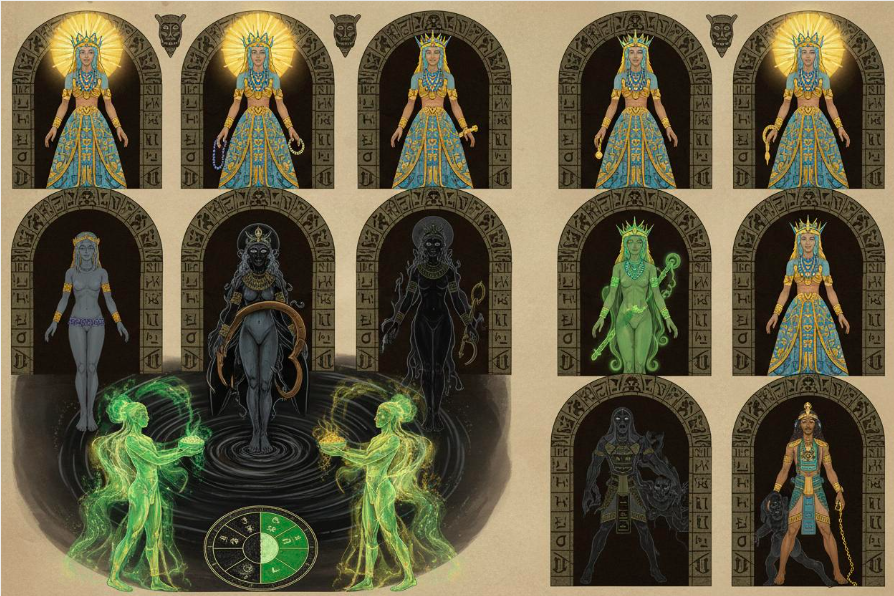
As Inanna approaches the underworld, its gatekeeper, Neti, receives instructions from Ereshkigal to admit her through seven gates.
At each gate, Inanna must surrender one item of her clothing, jewelry, or royal regalia. She protests, but the rule remains: she must enter according to the laws of the underworld. By the final gate, she has been stripped of the outward signs of her authority.
Imagine this.
The Queen of Heaven, who once entered rooms crowned in gold and lapis lazuli, stands before the Queen of the Dead with none of her familiar symbols of sovereignty.
Her crown is gone.
Her ornaments are gone.
Her royal garments are gone.
She cannot negotiate her way into remaining the woman she was before.
Inanna must face what exists beneath her titles.
The spiritual wisdom of the seven gates
The seven gates have become powerful symbols in modern spiritual interpretations of the myth. The following is a contemporary reflection, rather than a claim that the original Sumerians assigned each gate these particular psychological meanings.
Gate one — The identity you wear
Who are you when you can no longer rely on your title, reputation, achievements, or the image others have of you?
Wisdom: Your identity is larger than the role you play in the world.
Gate two — The need to be desired
Can you remain connected to your worth when you are not being pursued, admired, praised, or chosen?
Wisdom: Being desired is an experience. It is not the source of your worth.
Gate three — The illusion of control
Can you face the fact that you cannot control another person's heart, the timing of life, or every outcome?
Wisdom: Surrendering control is not the same as surrendering your standards.
Gate four — The mask of perfection
Can you acknowledge your longing, jealousy, grief, mistakes, and fears without abandoning yourself?
Wisdom: What you refuse to acknowledge can continue to govern you.
Gate five — The attachment to the past
What are you holding on to simply because it once made you feel alive?
Wisdom: Something can have been meaningful without being meant to remain.
Gate six — The fear of emptiness
Who are you when the distractions disappear and you must sit with what you feel?
Wisdom: Silence can reveal truths that constant activity conceals.
Gate seven — The surrender of the old self
Can you allow an old version of yourself to end without knowing exactly who you will become?
Wisdom: Transformation often begins before certainty arrives.
The deeper teaching is not that a woman must strip away her beauty, sexuality, or desire to become spiritually enlightened. Inanna's beauty and power are integral to her divinity.
Rather, the gates invite us to consider whether we are attached to these qualities as expressions of ourselves or dependent on them to feel worthy of existing. True sovereignty is not needing to abandon your radiance. It is knowing your radiance does not disappear when the world stops reflecting it back to you.
3. Meeting Ereshkigal: confronting the rejected self
At the heart of the underworld sits Ereshkigal, Inanna's sister and Queen of the Dead.
Inanna has entered Ereshkigal's domain, but she is no longer protected by her heavenly regalia. The seven judges of the underworld render their verdict against her. Inanna is struck down, dies, and her body is hung on a hook.
This is the darkest moment of the myth.
And it is important not to romanticize it: Inanna does not simply have a difficult conversation with her shadow. In the original story, she literally dies.
But through a symbolic, psychological lens, Ereshkigal represents a question that Inanna cannot answer through beauty, seduction, authority, or force:
Can you face the parts of existence that do not bend to your will?
Ereshkigal rules over what Inanna's heavenly realm cannot command. Death. Finality. The grief of the living. The darkness that does not disappear simply because we wish it away.
In a modern Jungian interpretation, we might see the sisters as contrasting aspects of the psyche:
Inanna: desire, ambition, erotic vitality, visibility, triumph, and the will to live.
Ereshkigal: grief, rage, mortality, rejection, buried pain, and the truths we would rather not confront.
This is a modern interpretive lens, not an established explanation of what the ancient author intended.
What wisdom emerges from their encounter?
The lesson is not that darkness is superior to light, or that a woman must suffer to become worthy of love.
It is that a life devoted exclusively to the beautiful, desirable, triumphant parts of ourselves remains incomplete.
You can be sensual and still grieve.
You can be powerful and still feel afraid.
You can be deeply loving and still experience rejection.
You can be a goddess of love and still encounter something you cannot make love you back.
Your shadow is not your enemy simply because it is uncomfortable. Sometimes it is the part of you that has been waiting to be acknowledged.
And yet, integration does not mean tolerating mistreatment or accepting harm. It means facing your inner truth without turning against yourself.
4. Inanna's death and resurrection: the wisdom of being restored
Inanna's faithful attendant, Ninshubur, remembers her instructions and seeks help. The god Enki intervenes, creating two beings who enter the underworld carrying life-giving substances. They respond to Ereshkigal's distress with compassion, receive Inanna's corpse, and restore her to life.
There is a subtle but beautiful element here.
Inanna does not save herself by becoming more seductive, more powerful, more impressive, or more invulnerable.
Her restoration comes through intervention and assistance.
Her attendant's loyalty matters. Enki's ingenuity matters. The act of responding compassionately to another's suffering matters.
The lesson of resurrection:
Sometimes we imagine that healing means becoming so strong that we never need anyone.
But Inanna's story suggests another possibility: sovereignty can include receiving help.
You can be independent and still need support.
You can be powerful and still be held.
You can be wise and still have moments when someone else's care makes your return possible.
And resurrection does not necessarily mean returning to your former life exactly as it was. It can mean coming back with a different understanding of yourself, your limitations, your relationships, and the value of life.
One caution: the original poem does not explicitly say Inanna returns with a modern therapeutic understanding of herself. That is the spiritual wisdom we can draw from the narrative, not a literal statement of her thoughts.
5. The price of returning: the lesson of reciprocity
Here is one of the most challenging parts of the story.
When Inanna is restored, the underworld authorities do not allow her to leave without consequence. She must provide a substitute to take her place.
As she returns to the world above, demons accompany her. They encounter various figures, including Ninshubur, who has mourned Inanna and remained loyal to her. Inanna refuses to surrender him. Eventually, she finds her husband, Dumuzi, who is not displaying the same signs of mourning. She designates him as her substitute. The myth ultimately establishes an arrangement in which Dumuzi and his sister Geshtinanna take turns in the underworld.
This ending is not a simple tale of spiritual enlightenment. It involves divine law, punishment, loyalty, and the consequences of returning from death.
But it raises a potent question for our own lives.
What must be left behind when we return from a transformative experience?
Perhaps it is an identity built around being chosen by someone else. Perhaps it is a pattern of abandoning your own needs to keep a connection alive. Perhaps it is the fantasy that if you love hard enough, you can control how another person treats you.
These are modern applications of the story, not the literal meaning of Dumuzi's fate.
The lesson is not to punish people who disappoint us. It is to recognize that our choices have consequences, and that returning to life means participating in its realities rather than remaining suspended in our desires.
Love does not erase accountability. Desire does not guarantee devotion.
And transformation is not complete merely because we have survived the darkest part.
We must also decide how we will live afterward.
6. The deepest wisdom of Inanna's descent
If we gather the story's central themes, we can understand Inanna's journey as a passage through five profound teachings.
1. Your worth exists beyond external validation.
Being admired, pursued, beautiful, successful, or desired can be wonderful. But none of these things should become the foundation upon which your entire sense of self rests.
2. The shadow deserves to be witnessed.
Grief, anger, longing, and fear are not automatically signs of failure. They are human experiences that can reveal what needs attention, boundaries, or healing.
3. Receiving support is not a loss of power.
The myth's rescue depends on loyalty, compassion, and the actions of others. Even a sovereign being does not exist in complete isolation.
4. Transformation requires change, not merely survival.
Returning to life also means facing the obligations and consequences that await you. Growth is expressed in how you live, not only in what you have endured.
5. You can return to the world without returning to your old self.
You may reclaim your desire, beauty, ambition, and joy while changing the patterns that once caused you to abandon yourself.
7. How Inanna's descent applies to love and feminine sovereignty
One of the most compelling ways to work with this myth is to consider the difference between being a woman who wants to be chosen and a woman who can choose consciously.
Inanna is a goddess of love and sexuality, but her story does not promise that desire will protect her from pain. Her descent invites us to explore what happens when the familiar sources of validation are no longer available.
In a modern relationship context, this might mean asking yourself:
Can I enjoy being desired without interpreting desire as a promise of commitment?
Can I feel disappointed when someone does not show up without deciding that I am somehow less worthy?
Can I remain open to love without trying to control its outcome?
Can I recognize another person's limitations without making it my mission to overcome them?
Can I leave a situation that does not meet my needs without treating that departure as a personal defeat?
This is where the myth becomes especially powerful.
The point is not to become cold, detached, or impossible to reach. Nor is it to pretend that you do not care.
It is to develop the capacity to care deeply while remaining connected to your own judgment.
You can be soft without being self-abandoning.
You can be sensual without making sex a substitute for emotional security.
You can be patient without waiting indefinitely.
You can love someone without making their decision to choose you the measure of your value.
And you can grieve a relationship or an unrealized possibility without losing your relationship with yourself.
The sovereign feminine does not have to stop desiring. She learns that desire is not a command to abandon herself.
8. A meditation inspired by Inanna
If you want to work with this story as a spiritual reflection, sit quietly and imagine yourself standing before the seven gates. You do not need to recreate the ancient ritual; simply use the imagery to contemplate what you are ready to release.
At each imagined threshold, ask yourself:
What identity am I afraid to lose?
Whose approval am I still trying to earn?
What am I attempting to control because uncertainty frightens me?
What feeling have I been unwilling to acknowledge?
What am I holding on to because I fear the emptiness that might follow?
What support would I allow myself to receive?
What must change for me to return to my life with greater integrity?
Do not force an answer. Let the questions sit with you.
Then imagine yourself emerging into the light — not as someone who has become invulnerable, but as someone who no longer needs to deny her vulnerability in order to feel powerful.
You may still want love. You may still want beauty, pleasure, intimacy, success, and recognition. You do not have to renounce the things that make you feel alive.
You are simply learning to hold them without allowing them to hold you captive.
The message of Inanna
Inanna's story is not a neat self-help allegory. It is an ancient, complex myth about divine power, mortality, the boundaries between worlds, and the costs of crossing them. Its spiritual meanings are interpretations we bring to a text that is much older than our modern language of healing.
Yet its imagery continues to speak to something deeply recognizable.
There are moments when life takes us through a gate we did not expect to enter. We lose certainty. We discover the limits of our influence. We encounter grief, desire, or fear that cannot be solved by being more beautiful, more accomplished, or more powerful.
We may feel stripped of everything that once made us feel secure.
But perhaps the question is not how to avoid every descent.
Perhaps it is how to meet the descent without abandoning ourselves.
And how, when we return, to carry our power differently.
You do not emerge from the underworld because you have conquered every darkness. You emerge because darkness is no longer the only truth you know.
That final thought is a modern spiritual reflection on Inanna's myth, rather than a quotation from the ancient poem.
The wisdom of her journey lies in holding both worlds: the light that allows us to flourish and the darkness that reminds us of our limits. Neither has to erase the other.
Inanna returns to the world above. And the question her story leaves us with is this:
When you return from your own underworld, what will you refuse to abandon yourself for ever again?