
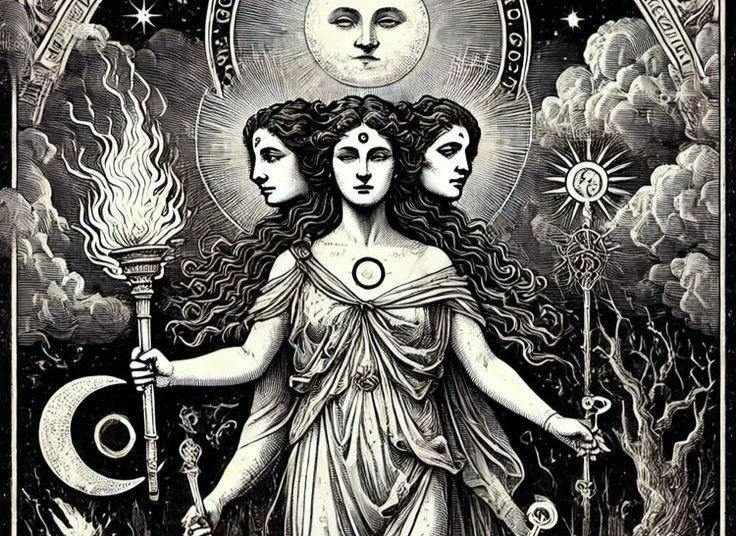
There is something profoundly beautiful about Hecate. She is not simply a goddess of darkness, witchcraft, or magic. She is the goddess who teaches us how to navigate the darkness without being afraid of it.
She represents the moments in life when we stand between who we once were and who we are becoming.
She is the keeper of thresholds, the guardian of hidden knowledge, the holder of the keys, and the woman who carries a torch into places where others are afraid to look.
Her message is essentially this:
You do not need to see the entire road ahead. You only need enough light to take your next step.
The story of Hecate
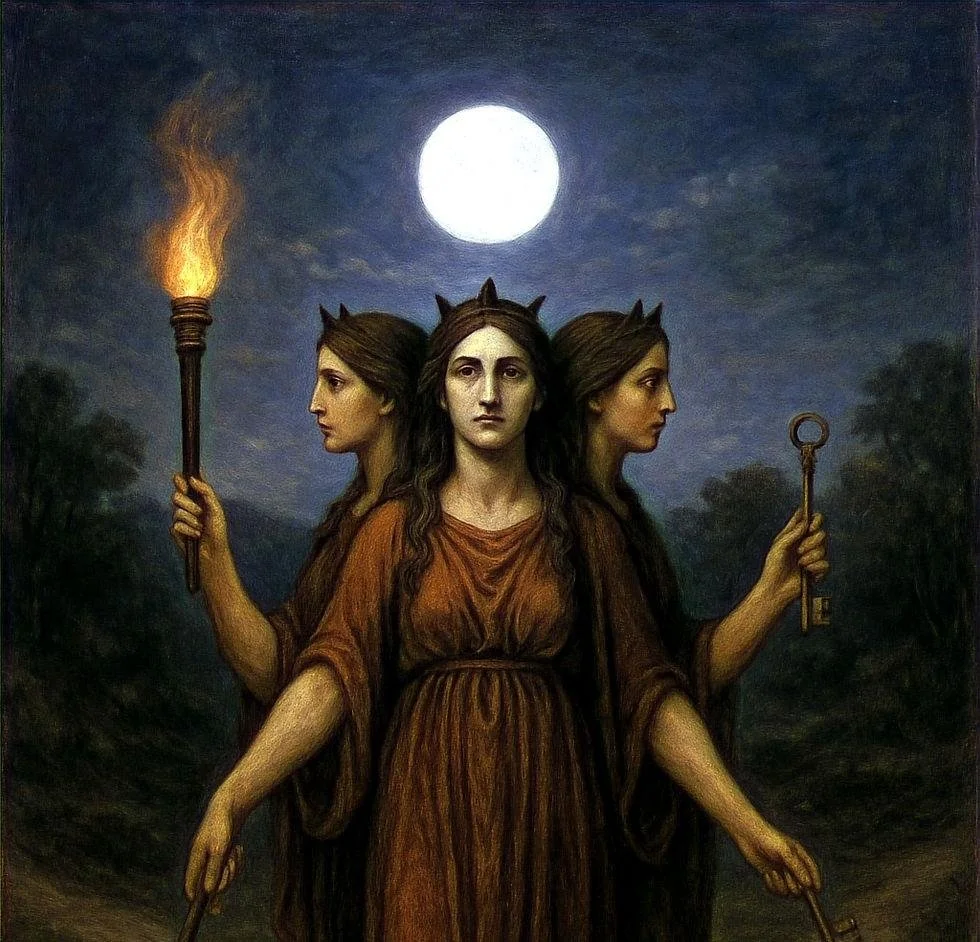
Hecate originates in ancient Greek mythology, although her roots and worship may reach further back into older Anatolian traditions. She was a powerful goddess associated with magic, the night, the moon, crossroads, spirits, protection, birth, and the unseen world. Unlike many figures in Greek mythology, Hecate retained her power even after Zeus became ruler of the Olympian gods.
In Hesiod's Theogony, Zeus honours her and allows her to retain her privileges across the earth, sea, and heavens. This is important because Hecate was not simply a goddess who belonged to one domain. She had influence across many realms. She was a goddess of the in-between.
And that is where her mythology becomes particularly fascinating.
1. Why she is the Goddess of the Crossroads
In ancient Greece, crossroads were considered mysterious and spiritually significant places.
Imagine standing where three roads meet.
One road leads backwards, towards everything you have known.
Another leads forward, towards the unfamiliar.
The third leads somewhere you have never considered travelling.
You must choose.
This is the symbolism of Hecate.
She was associated with three-way crossroads, places where different paths and possibilities converged. Her statues were sometimes placed at these intersections to protect travellers and guard against harmful spirits.
Her threefold imagery is often interpreted as representing her ability to look in multiple directions simultaneously.
The past: what you have experienced and must learn from.
The present: where you stand and what you must acknowledge.
The future: what is waiting to be discovered.
Hecate reminds us that crossroads are not necessarily places of confusion.
They are places of possibility.
Sometimes the most important spiritual transformation happens when we stop walking the road that everyone expects us to follow.
2. Why she moves between worlds
One of the most famous stories involving Hecate is the abduction of Persephone by Hades.
When Persephone disappeared, her mother Demeter searched desperately for her.
Hecate heard Persephone's cries.
Carrying her torches through the darkness, she approached Demeter and told her what she had heard. Eventually, Hecate became Persephone's companion, accompanying her between the upper world and the Underworld.
This is where Hecate's association with the boundaries between worlds becomes especially powerful.
She could move between the realm of the living and the dead, the visible and invisible, the conscious and unconscious.
She was not afraid of the Underworld.
She understood that darkness was not always something evil. Sometimes it was simply a place where transformation occurred.
Symbolically, this makes Hecate the goddess of transitions:
Endings and beginnings.
Life, death and rebirth.
Consciousness and the subconscious.
The known and the unknown.
The person you were and the person you are becoming.
She teaches us that we can enter periods of darkness without losing ourselves.
Sometimes we must descend before we can rise.
3. Why she carries the torch
The torch is perhaps the most beautiful symbol associated with Hecate.
In the story of Persephone, Hecate carries torches to illuminate the darkness while searching for the truth.
But the torch has a much deeper spiritual meaning.
It represents:
Illumination: seeing what was previously hidden.
Intuition: trusting the wisdom within yourself.
Truth: having the courage to acknowledge what you already know.
Protection: carrying your own light through uncertain circumstances.
Transformation: finding your way through darkness into a new chapter.
Hecate does not promise that the road will always be easy.
She promises, symbolically, that you can find your way.
There is a beautiful distinction here: she is not the light that prevents darkness from existing. She is the light that teaches you how to walk through it.
4. The keys, the dogs and the three faces
Three other symbols are particularly important.
The keys
Hecate is often depicted holding keys because she is the guardian of doorways and thresholds.
Spiritually, keys represent access to hidden knowledge, unlocking opportunities, protecting sacred spaces and opening doors to new possibilities.
She reminds us that not every door is meant to remain open, and not every door is meant to be closed forever.
The dogs
Dogs were sacred to Hecate in ancient traditions. Their association with her connected her to protection, the night, the boundaries between the living and the dead, and the ability to sense what humans might not perceive.
They represent guardianship, loyalty and instinct.
The three faces
Hecate is frequently depicted in triple form, with three bodies or faces looking in different directions.
Historically, this imagery was especially associated with her guardianship of three-way crossroads.
In modern spiritual interpretations, her three faces are also associated with the Maiden, Mother and Crone: the three archetypal stages of feminine wisdom.
This latter interpretation is a later spiritual association, rather than the original meaning of her ancient triple statues.
Together, these symbols make Hecate a goddess of boundaries, protection, wisdom and transformation.
5. Why November 16 is Hecate's Night
oday, November 16, is recognised in some modern Pagan and witchcraft traditions as Hecate's Night, a night for remembering, honouring and celebrating the goddess.
There is an important historical distinction worth knowing:
November 16 is a modern devotional observance. There is no established evidence that the ancient Greeks celebrated Hecate on this specific date.
In ancient Greece, Hecate was honoured through a monthly observance called Hekate's Deipnon.
This took place at the end of the lunar month, around the dark moon. People made offerings at crossroads, honoured the goddess, and performed household purification rituals.
The tradition of November 16 gives modern practitioners another dedicated opportunity to connect with her mythology and symbolism.
I find the symbolism of this observance particularly beautiful: it invites us to pause, examine where we are standing in life, release what no longer belongs to us, and consciously choose where we wish to go.
A prayer to Hecate: Keeper of the Crossroads
Hecate, Keeper of the Keys,
Torchbearer of the unseen paths,
Guardian of the crossroads and the mysteries of the night.
I honour your wisdom, your strength and your eternal light.
Walk beside me as I navigate the unknown.
Illuminate the truths I am ready to see.
Help me release what has reached its ending, and give me the courage to step towards what is waiting for me.
May I never mistake a closed door for rejection, a difficult ending for failure, or a period of darkness for the absence of light.
Teach me to trust my intuition.
Teach me to stand confidently at the crossroads of my own life.
May I have the wisdom to recognise which paths are meant for me, the courage to walk away from those that are not, and the strength to embrace the woman I am becoming.
Hecate, hold your torch high.
May I always find my way.
Blessed be.
The deeper message of Hecate for you
There is one particular aspect of Hecate's mythology that I think is worth sitting with.
She is a goddess of transitions.
She doesn't represent remaining in the same place forever. She represents having the courage to move between chapters.
Sometimes we reach a point in life where the old version of ourselves no longer fits, but the new version has not fully emerged.
That is the crossroads.
And it can feel lonely, uncertain and unfamiliar.
But perhaps that is where Hecate's greatest teaching lies.
You don't need to chase what is leaving. You don't need to force what is coming. You don't need to have every answer.
You simply need to keep your torch burning.
Your past does not own you. Your present does not define your limitations. Your future is not yet written.